
RobotCore Mini: Compact x86 Robot Computer for ROS 2, Autonomous Robots and Sensor Fusion
Compact Computing Built for Robots, Not Desktops
Modern autonomous robots require much more than a conventional mini PC.
A mobile robot may need to connect LiDAR, cameras, IMUs, RTK receivers, motor controllers and other sensors while running ROS 2, SLAM, navigation and perception algorithms. At the same time, the onboard computer must remain compact, lightweight and reliable in a moving and vibration-prone environment.
RobotCore Mini is a compact x86 computing platform designed specifically for robotics and unmanned systems.
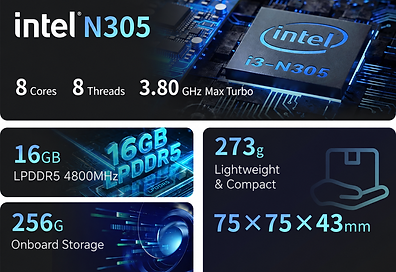
Powered by an Intel i3-N305 processor, the system combines x86 computing, robotics-oriented communication interfaces, an integrated ESP32 MCU, synchronized trigger I/O and peripheral power outputs in a chassis weighing approximately 273 g.
It is designed for applications including:
-
Autonomous mobile robots
-
Unmanned ground vehicles
-
Inspection robots
-
UAV and unmanned platforms
-
SLAM and mapping systems
-
Multi-sensor fusion platforms
-
Robotics research and rapid prototyping
The Solution: One Compact Computer for Computing, Communication and I/O
RobotCore Mini combines three layers that are often implemented using separate devices:
x86 Computing
Run high-level robotics software, ROS/ROS2, SLAM, navigation and application algorithms.
Integrated MCU
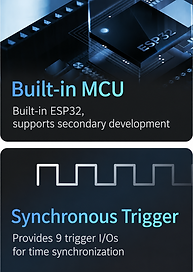
An onboard ESP32 provides a programmable embedded control layer for secondary development.
Robotics I/O
CAN, UART, Ethernet, USB, trigger signals and external power interfaces allow direct connection to common robotic sensors and controllers.
This architecture helps developers reduce external modules, wiring complexity and integration effort when building autonomous robotic systems.
.png)
.png)
.png)
Why RobotCore Mini Is Different
1. x86 Architecture for Mainstream Robotics Software
RobotCore Mini uses an x86 architecture and supports Windows, Ubuntu, ROS and ROS 2, allowing developers to work within mainstream robotics development environments.
This makes it suitable for deploying algorithms for:
-
SLAM
-
Localization
-
Navigation
-
Mapping
-
Sensor processing
-
Robot control
-
Multi-sensor data acquisition
-
Robotics middleware
For teams already developing on desktop x86 computers, the architecture can also help reduce software migration effort when moving algorithms onto the robot.

2. Integrated ESP32 MCU for Secondary Development
A robot often needs both high-level computing and low-level event handling.
RobotCore Mini integrates an ESP32 MCU directly into the platform, giving developers an additional programmable control layer without necessarily adding a separate MCU board.
The MCU can support functions such as:
-
Camera triggering
-
External event inputs
-
Sensor synchronization
-
Device coordination
-
Custom hardware control
This enables the x86 processor and embedded MCU to handle different parts of the robotic workload within the same compact system.
.png)
3. Nine Trigger I/O Channels for Sensor Synchronization
Multi-sensor systems often need accurate synchronization between cameras, sensors and external events.
RobotCore Mini provides 9 trigger I/O channels that can be used for:
-
Camera triggering
-
Sensor synchronization
-
External event capture
-
Coordinated device control
This makes the system particularly useful for robotics perception, data collection, mapping and multi-sensor fusion applications.
4. Robotics-Oriented Connectivity
RobotCore Mini provides a wide range of interfaces for connecting sensors and robotic hardware.
Available interfaces include:
-
Dual 2.5G Ethernet
-
CAN
-
UART
-
USB 3.0
-
USB 2.0
-
USB Type-C
-
Trigger I/O
-
TF / MicroSD
-
5V peripheral power
-
12V peripheral power
A single computer can therefore connect directly to devices such as:
LiDAR + Camera + IMU + RTK + Motor Controller + Sensors
This can simplify the overall robot electrical architecture.
5. Anti-Loosening Connectors for Mobile Robots
Robots move. Their cables move with them.
RobotCore Mini uses GH1.25 anti-loosening connectors for multiple interfaces to create a more compact wiring layout and reduce the risk of cable disconnection during robot motion or vibration.
Compared with standard USB or RJ45 connectors, compact locking connectors can provide:
-
More compact cable routing
-
Reduced connector footprint
-
Improved resistance to vibration
-
Lower risk of accidental cable disconnection
This is particularly valuable for mobile robots, inspection platforms and unmanned vehicles.
.png)
.png)
6. Integrated 5V and 12V Peripheral Power
Robot sensor systems often require several voltage levels, which can result in additional power converters and complex wiring.RobotCore Mini provides 5V and 12V peripheral power outputs directly from the computer.The 5V outputs can be used with devices such as:Digital sensorsCommunication modulesPositioning modulesVision peripheralsThe 12V outputs can support equipment such as:LiDARIndustrial sensorsCooling systemsLighting devicesOther higher-power robotic peripheralsA USB port can provide up to 5V / 2A output according to the product documentation.By integrating peripheral power distribution, the platform can reduce the number of additional power modules required inside the robot.
7. Compact and Lightweight for Onboard Integration
RobotCore Mini measures approximately:
75 × 75 × 43 mm
and weighs approximately:
273 g
The compact form factor makes it suitable for integration into space-constrained robotic platforms where traditional industrial PCs may be too large.
Potential platforms include:
-
Small autonomous mobile robots
-
Research robot chassis
-
Delivery robots
-
Inspection robots
-
UAV payload systems
-
Portable mapping systems


Applications
Application Case 1: Autonomous Mobile Robot / UGV
For an autonomous mobile robot, RobotCore Mini can act as the central onboard computer.
A typical architecture can include:
LiDAR → RobotCore Mini
Camera → RobotCore Mini
RTK → RobotCore Mini
IMU → RobotCore Mini
Chassis Controller → CAN/UART → RobotCore Mini
The x86 processor can run perception, localization, SLAM, navigation and high-level control software, while the integrated communication interfaces connect the computing layer directly to sensors and chassis hardware.
Suitable applications
-
Autonomous mobile robots
-
Patrol robots
-
Delivery robots
-
Research mobile platforms
-
Unmanned ground vehicles

Application Case 2: UAV and Unmanned Systems
Weight and installation space are critical in UAV and unmanned-system development.
At approximately 273 g, RobotCore Mini provides an x86 computing environment together with multiple sensor interfaces in a compact package.
The platform can be used as an onboard computing or data-processing unit where developers need to integrate cameras, positioning sensors, communication devices or other mission payloads.
Potential applications include:
-
UAV research platforms
-
Autonomous navigation development
-
Aerial perception systems
-
Multi-sensor payloads
-
Experimental unmanned systems

Application Case 3: Multi-Sensor Fusion and SLAM Platform
RobotCore Mini can also serve as the computing and synchronization hub for a multi-sensor acquisition system.
A typical setup may combine:
LiDAR + Camera + IMU + RTK + Trigger Signal
The integrated trigger I/O can be used to coordinate sensor acquisition, while x86 computing provides the environment for ROS/ROS2, SLAM and sensor-processing algorithms.
This makes the platform suitable for:
-
SLAM development
-
Handheld mapping systems
-
Sensor acquisition boxes
-
Sensor calibration platforms
-
Robotics perception research
-
Autonomous driving research platforms

Frequently Asked Questions
What is RobotCore Mini?
RobotCore Mini is a compact x86 computer designed for robots and unmanned systems. It combines an Intel i3-N305 processor, 16 GB LPDDR5 memory, 256 GB storage, an integrated ESP32 MCU and robotics interfaces including Ethernet, CAN, UART, USB and trigger I/O.
Can RobotCore Mini run ROS 2?
Yes. The platform uses an x86 architecture and is designed to support Ubuntu, ROS and ROS 2 development environments.
Can it be used as the main computer for a mobile robot?
Yes. It can connect to LiDAR, cameras, RTK, IMU and chassis controllers and can be used for perception, localization, navigation and control applications.
Does RobotCore Mini support CAN?
Yes. The platform includes a CAN interface for connecting compatible robot controllers and devices.
Does it support sensor synchronization?
Yes. RobotCore Mini provides nine trigger I/O channels that can be used for camera triggering, sensor synchronization, external events and device coordination.
Does RobotCore Mini include an MCU?
Yes. An ESP32 MCU is integrated into the system and supports secondary development and custom hardware functions.
Can RobotCore Mini power external sensors?
The platform provides 5V and 12V peripheral power interfaces. These can reduce the need for separate power modules for compatible sensors and peripherals.
What is the size of RobotCore Mini?
The unit is approximately 75 × 75 × 43 mm and weighs approximately 273 g, making it suitable for compact robotic platforms.
What robots can use RobotCore Mini?
Typical applications include autonomous mobile robots, unmanned ground vehicles, inspection robots, delivery robots, UAV systems, SLAM platforms and multi-sensor data acquisition systems.